Buy as Business in India
Project Details
Tool: Figma, AI prototyping
Company LinkedIn
Time: 2025 Feb. - May.
As the sole designer on the project, I partnered with Product, Engineering, Finance, Business, and Tax teams to produce MVP-phase design deliverables, shape the long-term vision, and scope a phased roadmap that balanced user needs and technical constraints.
The project creates a smooth checkout experience for customers purchasing on behalf of their business,
while helping LinkedIn establish a selling entity in India and ensure its compliance.
It also gave customers a consistent billing experience across markets, backed by a shared component flexible enough to handle local edge cases and scale across multiple lines of business.
Customer & Business Impact
For customers
Business owners in India now get a smooth checkout experience that meets local compliance requirements. Instead of manually sharing business details, they simply enter a tax ID, and the system automatically retrieves their registered business information.
For LinkedIn
For LinkedIn, this establishes the company's 6th selling entity, meeting India's Ease of Doing Business requirements and aligning with local regulations that keep revenue within the country. New purchases through the India entity go live April 1, 2026.
From the initiative to the root problem
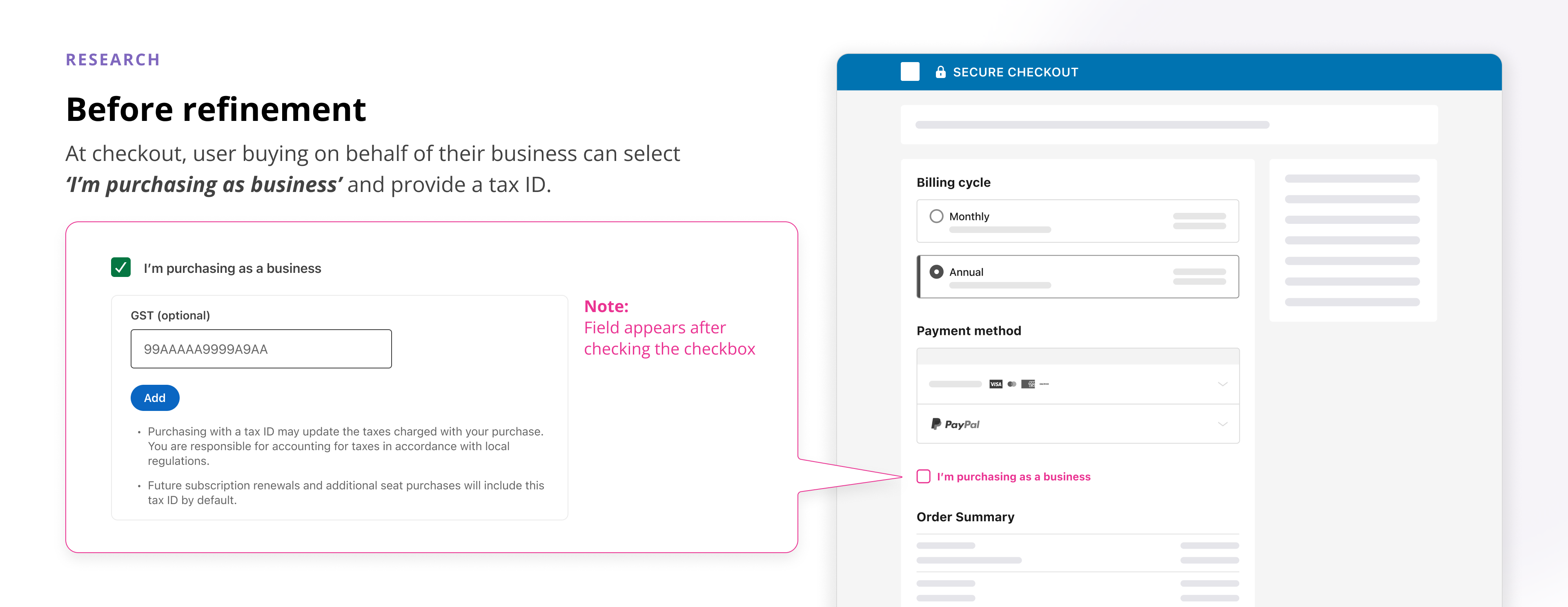
Today, when customers buy on LinkedIn, they can select 'I'm purchasing as business' during checkout and provide a tax ID. But they can't add other key business details, such as company name or address. This gap became a challenge in markets like India, where compliance requires full business information to establish a local selling entity.
Getting to the root: expanding project scope to solve the real problem
While compliance was the initial driver, the design process uncovered a deeper issue:
LinkedIn customers lacked a true business account structure.
As we mapped the end-to-end workflow and audited the post-purchase experience, we saw how difficult it was for users to manage both personal and business purchases under the same account, with personal and business information mixed together.
Addressing Indian compliance opened the door to a broader account structure solution, tackling a systemic design and data problem that had long existed across the platform.
The underlying problem: Buy as a business, but not really
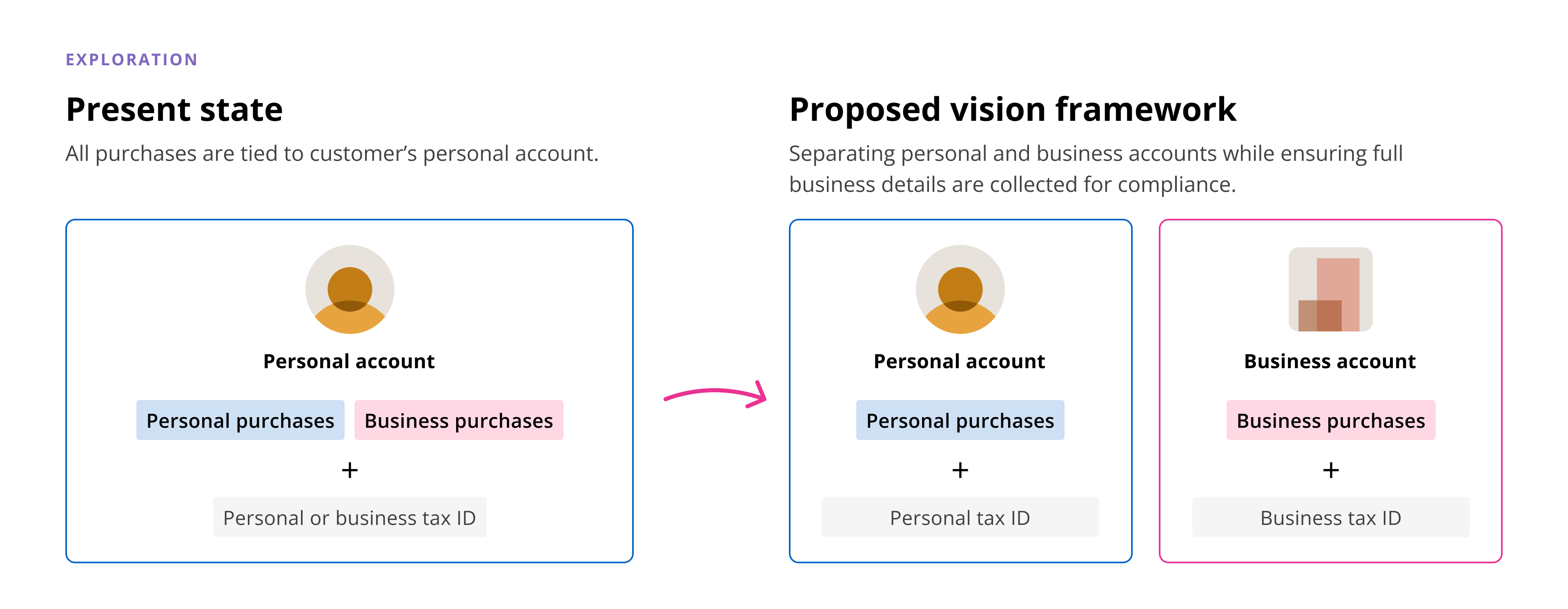
Account structureCustomers buying on behalf of their business struggled because purchases were tied to their personal accounts. This made it harder to organize transactions, and tax details often became confusing since they weren't clearly linked to the business.
Defining a VisionFrom this realization, we set out a vision beyond fixing compliance in one market. The goal was to resolve core data misalignment by introducing a true business account structure that separates personal and business purchases and ensures taxes and records are applied at the business level.
Designing the Path: MVP to Vision
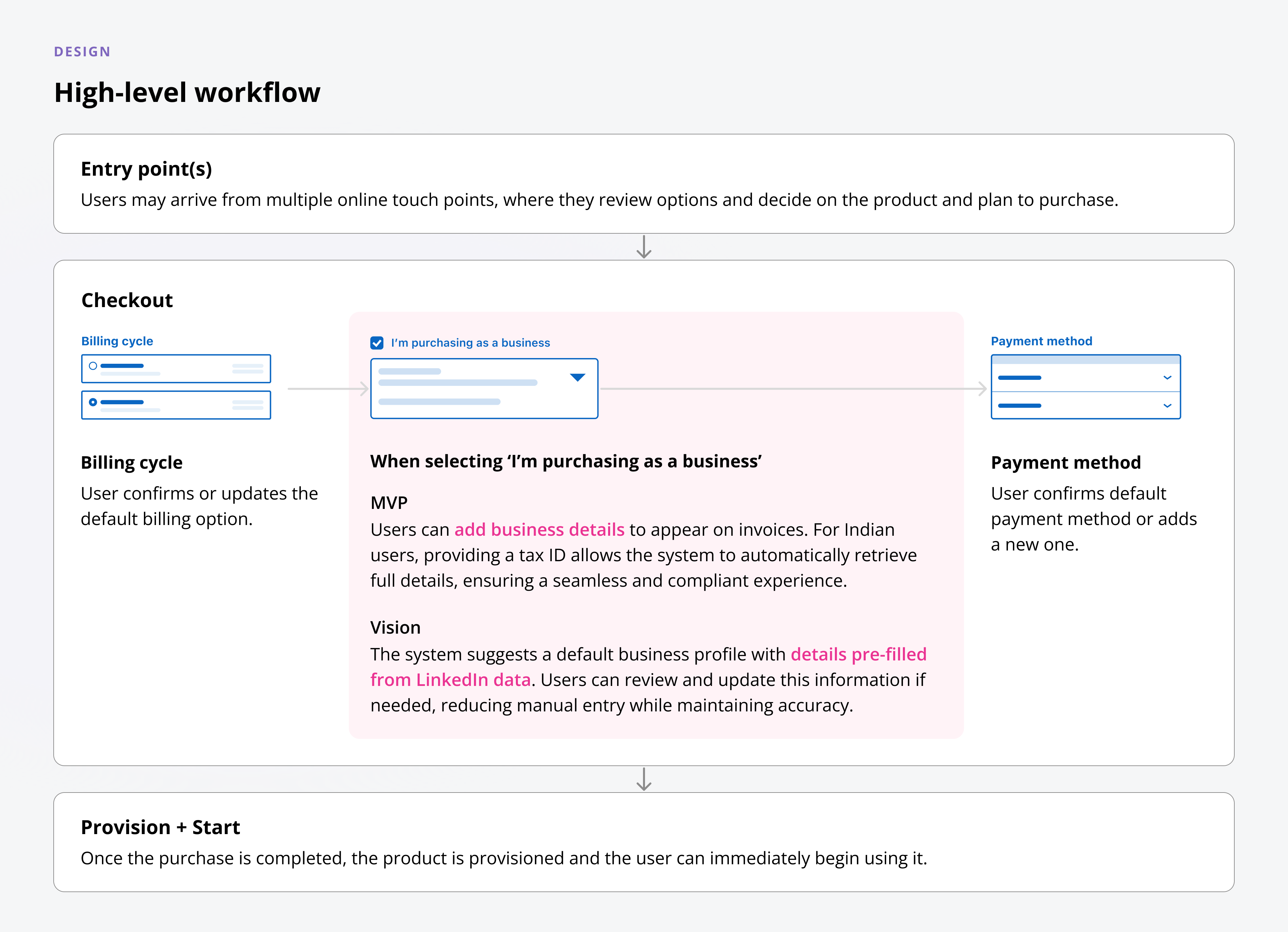
I tackled the challenge in two steps:
- Delivered a quick compliance fix to support the India selling entity, aligned with LinkedIn's go-to-market strategy for the region.
- Envisioned a future where LinkedIn data makes business purchases faster and easier for users everywhere.
Example persona
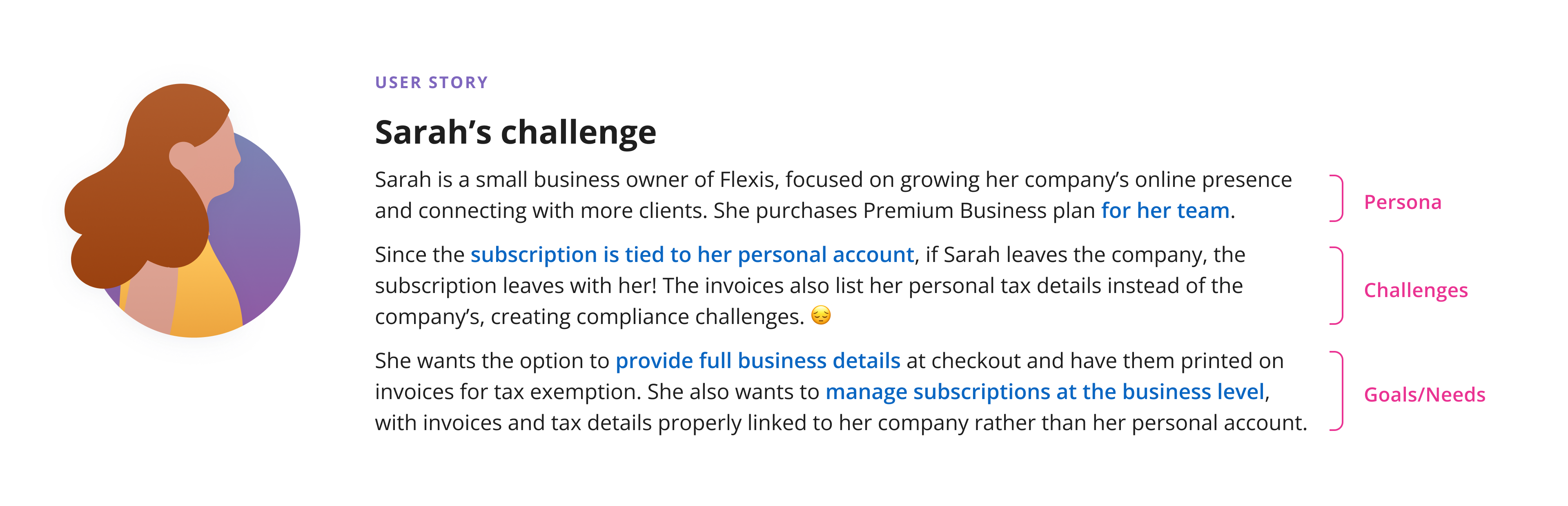
To illustrate these challenges, let's look at Sarah's story.
Product screenshot
MVP: Building the foundation through India
Sarah simply provides a tax ID, and her official business details are automatically retrieved, creating a smoother checkout experience for small business owners like her.
Getting there wasn't straightforward. Rather than defaulting to a fully manual form, I pushed to find a faster way for users to input their business information. Through competitive research, I found that other platforms used government APIs to look up registered business details, so I collaborated with Engineering to explore a similar approach.
In this experience, Sarah simply shares her GSTIN (Tax ID), which we use to automatically retrieve her registered business details.
If users prefer not to use autofill, they can choose to manually enter their business information instead.
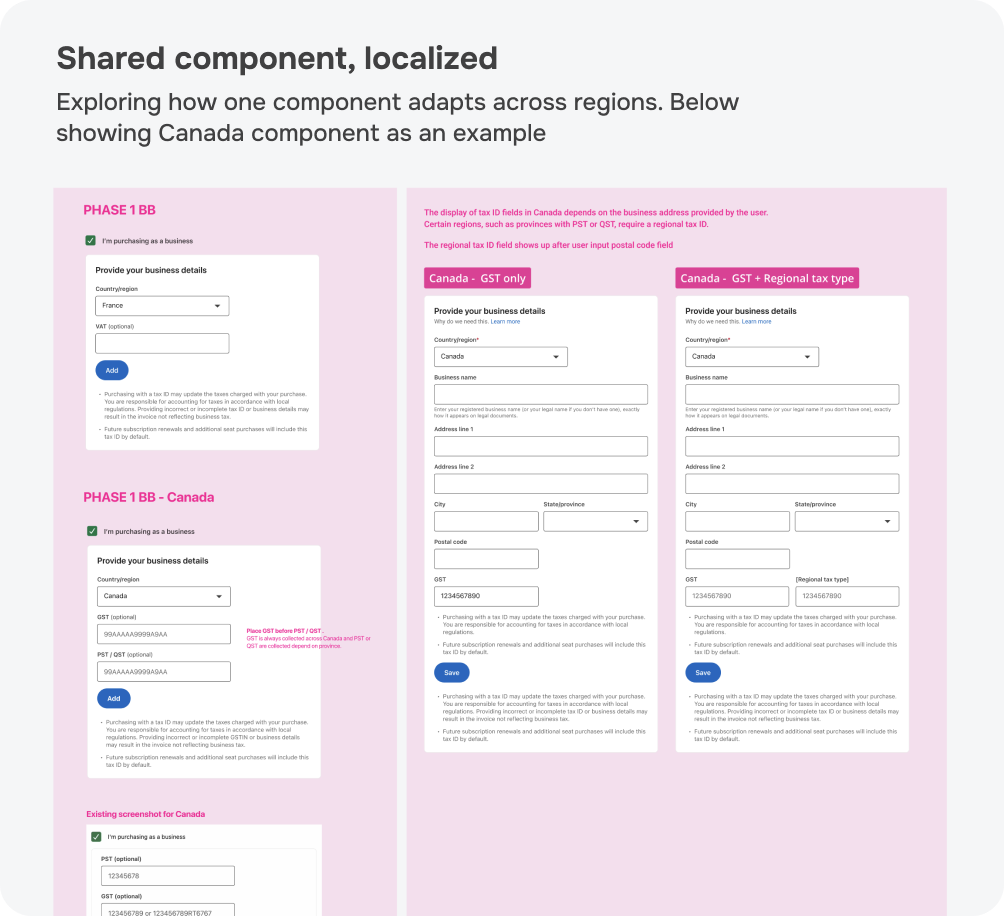
Localizing a shared component
Rather than building a one-off form for India, I designed the business billing details collection form as a shared component that adapts to where a business is based. Business registration requirements differ by market: India needs GST and PAN, other markets rely on VAT numbers or local company registration IDs, so the fields, labels, and validation shown change based on the location selected at checkout.
This meant the form stayed focused and free of irrelevant fields for each locale, while giving LinkedIn a single, scalable pattern it can extend to future selling entities without redesigning checkout from scratch each time.
Video walkthrough
Vision: A smarter way to gather information
While the MVP addressed immediate compliance needs, our long-term vision was to streamline the experience across all markets. By leveraging members' existing data such as work experience and company pages, the system could pre-populate business details at checkout.
This would ensure a seamless purchase experience, with accurate business information and invoices users can trust.
Highlights of my design approach
In this case study, I demonstrate two key aspects of my design approach:
By exploring user pain points, we uncovered a deeper account structure issue and reframed the project from a local fix to a systemic global solution.
I improved the user experience by researching industry standards and collaborating with engineering to overcome tax ID collection constraints.
Why This Matters in My Portfolio
- Systems thinking. Reframed a single-market compliance requirement as a deeper account structure gap, expanding the scope from a local fix to a global, scalable solution.
- Cross-functional alignment. Partnered with Product, Engineering, Finance, Business, and Tax across 21 workstreams to ship an MVP while shaping a long-term roadmap.
- Pushing technical limitations for better UX. Researched industry standards and collaborated with Engineering to explore using a government API for GSTIN lookups, reducing manual input for users.